
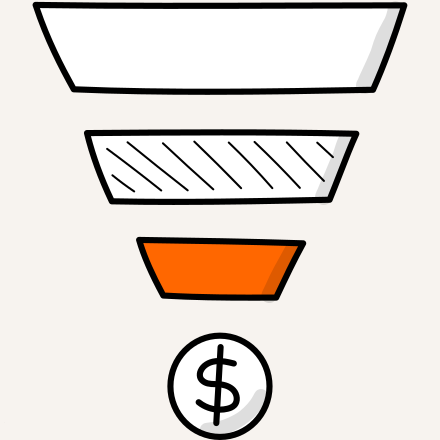
Middle of Funnel Content Marketing SEO Services
Middle of Funnel Content Marketing SEO services guide buyers through evaluation, comparison, and trust-building using case studies, product guides, and decision-stage assets that support sales conversations and informed purchase decisions across complex B2B journeys globally
MOFU SEO Services
Case Study Creation
Case studies guide evaluators by documenting context, selection rationale, deployment steps, and outcomes. Within middle of funnel content marketing SEO, these narratives help buying committees validate fit, reduce perceived risk, align stakeholders, and move discussions forward using concrete evidence rather than promises during lengthy consideration cycles across complex purchasing environments.
Product Comparison Guides
Comparison guides structure feature differences, limitations, pricing logic, and use scenarios. A MOFU content marketing agency uses these assets to support fair evaluation, shortlist formation, internal justification, and consensus building when multiple vendors appear similar during buyer research across cross-functional teams, reducing confusion, delays, and stalled decisions later stages overall.
Solution-Focused Blogs
Solution-focused blogs explore specific challenges, compare approaches, and explain tradeoffs buyers face. Through MOFU content SEO services, this content addresses informed questions, supports self-education, and positions solutions logically without promotional pressure during active evaluation phases for technical reviewers, operational stakeholders, and commercial evaluators seeking clarity before advancing discussions internally further.
Webinar & Demo Content
Webinars and demos present workflows, live scenarios, and expert explanation for deeper review. An SEO-driven MOFU content strategy ensures these assets reach evaluators researching implementation detail, encouraging informed dialogue and shared understanding before direct sales involvement with multiple stakeholders, supporting alignment, expectation setting, and confidence during midcycle assessments phases overall.
FAQ & Troubleshooting Pages
FAQs and troubleshooting pages address recurring concerns uncovered during product review. A content marketing SEO agency for MOFU structures answers around real evaluation barriers, helping teams resolve doubts, prepare internal responses, and maintain progress across complex decision paths involving legal, finance, operations, and procurement reviewers simultaneously without unnecessary friction introduced.
ROI & Benefits Content
ROI and benefits content supports financial scrutiny by outlining cost factors, return logic, and operational impact. This material helps stakeholders build justification narratives grounded in realistic assumptions rather than speculative claims, supporting budget approvals, forecasting discussions, and internal alignment during consideration cycles across departments, procurement, finance, leadership, reviews, phases, enterprise.
E-Books & Whitepapers
E-books and whitepapers compile research, frameworks, and comparative insight into reference assets. These formats support structured evaluation, internal knowledge sharing, and informed consensus when decisions involve multiple reviewers across departments, timelines, risk assessments, and compliance considerations common in enterprise purchasing environments with layered approvals, documentation, scrutiny, governance, requirements, globally, today.
Customer Testimonials SEO
Customer testimonials framed for search highlight peer experience, context, and outcomes. Content SEO for lead nurturing stages organizes these stories to reassure evaluators, support credibility checks, and reinforce confidence as buyers approach final selection within committees, balancing risk, proof, and internal accountability expectations during vendor approval processes enterprise wide reviews.
Email Nurture Content SEO
Email nurture content delivers sequenced guidance aligned with evolving buyer questions. Messaging reinforces understanding over time, revisits key considerations, and supports informed progression by keeping evaluation context consistent between research moments and stakeholder discussions without urgency cues during long cycles, multiple touchpoints, internal reviews, and decision handoffs common in B2B.
EXCELLENT Based on 8 reviews
 Posted on Google
 Lily DavisI worried about seo cost at start but they explained pricing clearly. They helped setup website pages, fix meta, and suggest local seo changes. Few months later, leads started coming slowly. Work is professional and honest, really recommended.Posted on Google
 Pt. Shivam SharmaLink building helped my ecommerce site, small improvement in visibility.Posted on Google
 Anika AndraThey were recommended by a friend after our previous agency used spammy links. Jay Patel cleaned those links and fixed on page issues. Rankings dropped first, then slowly started stabilizing, which gave us confidence.Posted on Google
 vanip patelJay built my eCommerce website from scratch for my store in Canada. I’m happy to recommend him for website design and development. He also handled local SEO optimization, and I’m now selling many products online organically.Posted on Google
 Aanchal RathorWe contacted Jay Patel because our website traffic suddenly dropped after a redesign. He checked our site and found indexing and on page issues we didn’t know about. Fixes were done step by step. Traffic hasn’t fully recovered yet, but direction is clearly improving.Posted on Google
 Prashant NavaleWe hired Jay Patel after our website was not getting any organic leads for months. He first explained what was wrong instead of selling packages. Seo work is still ongoing, but impressions and clicks are improving slowly. This feels more real compared to our past experience.Posted on Google
 Dhrupal Patel"LHighly impressed with XSquareSEO's services! They've significantly boosted my website's visibility and rankings. The team is knowledgeable, responsive, and delivers results. Definitely a five-star SEO company!




4M +
Keywords Ranked
95 %
Client Retention
38 +
Projects Delivered
3 +
Years in Business
Your Top of Funnel Brings 30,000 Visitors a Month. 80 Percent Leave Without Moving Closer to a Purchase. The Middle Is Missing.
The blog ranks. The informational guides generate traffic. Thirty thousand visitors arrive every month through top-of-funnel content targeting awareness-stage keywords. They learn that a problem exists. They learn that solutions exist. Then they leave. Not to your competitor – not yet. They leave because your site gave them awareness without giving them the next step: content that helps them evaluate their options, compare approaches, and build the criteria they will use to make a purchase decision.
The middle of the funnel is where a visitor becomes a prospect. They arrived knowing nothing. Your top-of-funnel content taught them they have a problem. Now they need content that helps them evaluate solution categories, understand the trade-offs between approaches, and develop the buying criteria that will eventually lead them to a provider. Without this content, they leave your site and search for it elsewhere. The competitor whose site provides the evaluation-stage content earns the trust. When the buyer reaches the decision stage, they choose the provider who guided their evaluation – not the one who only introduced the problem.
XSquareSEO’s middle of funnel content services build the evaluation layer your site is missing. We create the buyer’s guides, comparison content, framework articles, and decision-support resources that keep visitors on your site as they move from awareness to consideration. A middle of funnel marketing agency that only produces top-of-funnel blog posts is an agency that fills the top of the funnel and lets 80 percent of the visitors it attracted leak out before they ever see a service page. We build the content that captures them in the middle and moves them toward the bottom.
“How to Choose” Keywords Convert at Three Times the Rate of “What Is” Keywords. Your Content Calendar Ignores Them.
“What is CRM software” is a top-of-funnel query. The searcher is learning a concept. Conversion rate: under 1 percent. “How to choose CRM software for a small team” is a middle-of-funnel query. The searcher has decided they need CRM software and is now evaluating how to select the right one. Conversion rate: 2 to 4 percent. The second keyword generates a visitor who is further along in the buying process, closer to engaging a provider, and more likely to take an action on your site than the first keyword. Yet most content calendars are packed with “what is” posts and empty of “how to choose” guides.
Middle-of-funnel keywords carry evaluation modifiers: “how to choose,” “guide to selecting,” “things to consider before buying,” “questions to ask your [provider],” “[category] for [specific use case],” “[solution type] checklist.” These keywords have lower search volume than awareness-stage queries but each visitor they attract arrives with purchase consideration already in progress. The searcher does not need to be convinced a problem exists. They need help evaluating which approach solves it.
Our middle of funnel SEO services target evaluation-stage keywords as a distinct campaign layer. We map every “how to choose,” “guide to,” “checklist,” and “questions to ask” keyword in your industry, build the content that satisfies each query, and optimise each page for the intent Google has validated by examining what currently ranks. The content calendar shifts from 100 percent awareness posts to a strategic mix where middle-of-funnel content captures the visitors whose proximity to a purchase decision makes them three times more valuable per visit than the readers your top-of-funnel attracts. A MOFU SEO company that does not separate content by funnel stage produces uniform content for non-uniform buyers – and loses the ones who matter most to a competitor who spoke to them where they actually are in the decision process.
A Buyer’s Guide Positions You as the Authority Before the Buyer Ever Sees Your Service Page.
A visitor who reads your 3,000-word guide on “How to Choose an IT Managed Services Provider” spends eight minutes on your site absorbing your expertise. They learn the evaluation criteria. They learn the red flags. They learn the questions to ask prospective providers. By the time they click through to your managed services page, they have already spent more time with your brand than they will spend with any competitor they evaluate later. The trust was built during the evaluation stage. The service page confirmation stage is a formality.
This is the asymmetric advantage middle-of-funnel content creates. The provider who educates the buyer during the consideration phase sets the evaluation criteria. If your buyer’s guide says “ask your provider about their average response time to critical tickets,” and your service page prominently features your 15-minute critical response SLA, the evaluation criteria and the proof are both on your site. The competitor who did not publish a buyer’s guide has to hope the buyer asks the right questions independently – which they will, because your guide taught them to.
XSquareSEO creates buyer’s guide content as a core deliverable of our middle of funnel content marketing services. Each guide targets a high-value evaluation keyword, covers the decision criteria comprehensively enough to rank as the most useful resource for that query, and includes internal links to your service pages at contextually appropriate points. The guide ranks. The visitor reads it. The internal links move them to your commercial pages. The trust transfers from the guide to the service. A middle of funnel SEO agency that does not build buyer’s guides is missing the content type that establishes authority at the exact moment the buyer is deciding who to trust with their evaluation.
An Email Captured at the Consideration Stage Is Worth Ten Times a Social Media Follower. Your MoFu Content Should Capture It.
A visitor reading your evaluation-stage content is a potential buyer who has not yet chosen a provider. Capturing their email address at this moment – through a downloadable checklist, a comparison framework, an ROI calculator, or an evaluation template – enters them into a nurture sequence that keeps your brand present throughout their decision process. They may not convert today. They may convert in three weeks after receiving four emails that provided additional evaluation support, addressed common objections, and linked to case studies demonstrating results.
This email list is invisible to your competitors. They cannot bid on it in Google Ads. They cannot outrank it in search results. They cannot target it on social media. The list belongs to you, contains prospects who have already engaged with your evaluation content, and converts at a rate that exceeds every other marketing channel because the subscriber opted in during a moment of active purchase consideration.
Lead capture through gated middle-of-funnel resources is a standard deliverable in our MOFU content services. We create the downloadable resource – the checklist, the comparison matrix, the evaluation scorecard – and integrate it into the evaluation-stage content your site publishes. The resource matches the intent of the article: a reader of “How to Choose a Digital Marketing Agency” receives a downloadable “Agency Evaluation Scorecard” that systematises their comparison process. The capture is contextual, not interruptive. The value exchange is genuine. The prospect enters a nurture sequence designed to move them from consideration to decision over the next 14 to 30 days. A middle of funnel content strategy without email capture is a strategy that educates buyers and then releases them to evaluate competitors without maintaining any connection to your brand during the weeks between consideration and purchase.
Category Comparison Content Ranks for the Queries That Precede Every Purchase Decision Your Buyers Make.
Before a buyer chooses between providers, they choose between solution categories. “In-house team vs agency.” “Cloud software vs on-premise.” “Managed services vs break-fix support.” These are middle-of-funnel queries where the buyer is deciding which approach to take before they decide which provider to hire. The content that ranks for these queries captures the buyer at a moment when the decision about which category of solution to pursue is still open – and the provider who publishes the comparison earns the authority to influence which category the buyer selects.
Category comparison content is distinct from the provider comparison content that belongs at the bottom of the funnel. A BOFU page compares “HubSpot vs Salesforce.” A MOFU page compares “CRM software vs spreadsheet-based tracking.” The MOFU comparison captures buyers earlier in the process, before they have decided which category they belong in. If your comparison content demonstrates that CRM software solves problems spreadsheets cannot, the buyer moves into the CRM category – and your brand is the one that guided them there.
Our middle of funnel SEO strategy includes building category comparison pages for every solution-category decision your buyers face before they reach the provider-selection stage. We identify the category-level comparisons relevant to your industry, create content that evaluates both sides factually while demonstrating where your solution category delivers superior outcomes, and optimise each page for the comparison keyword Google currently ranks results for. The buyer who arrives at your service page after reading your category comparison has already been convinced that your category is the right approach. The remaining decision is which provider within that category to hire – and you are already the trusted advisor because you provided the comparison that guided the category decision. That positioning advantage is what middle of funnel marketing services deliver when the content captures buyers at the evaluation stage rather than waiting until they have already chosen the category and are comparing providers.
The Buyer Has Objections. Your Content Does Not Address Them. They Leave With Doubts Your Competitor’s Content Resolves.
Every buyer at the consideration stage carries objections. “Is this too expensive for what we get?” “Will this actually work for our specific situation?” “What if it takes too long to see results?” “What if we commit and it does not deliver?” These objections live in the buyer’s mind during the evaluation phase. If your content does not surface and address them, the buyer carries the doubt forward into the decision stage. The doubt makes them hesitant. The competitor whose content addressed the objection during the consideration stage removed the hesitation before it had time to calcify.
Objection-addressing content is not defensive. It is strategic. A piece titled “Is SEO Worth the Investment for a Small Business?” directly addresses the cost objection with ROI math, case study evidence, and a realistic timeline that sets accurate expectations. A piece titled “How Long Does SEO Take to Produce Results?” addresses the timeline objection with data-backed benchmarks that prevent the buyer from setting unrealistic expectations that lead to disappointment. Each article targets a keyword the buyer actually searches and resolves a barrier that would otherwise stall their progress toward a purchase.
We identify and build objection-addressing content as part of every middle of funnel content marketing engagement. We audit the common objections your sales team encounters during calls, map each objection to a keyword that buyers search, and create content that resolves the objection with evidence rather than reassurance. The content ranks for the objection keyword, capturing buyers who are actively searching for resolution. The content also serves as a nurture sequence asset that can be sent to prospects who expressed the objection during a sales conversation. A professional middle of funnel SEO service builds content that sells by removing the reasons buyers hesitate – not by pushing harder but by providing the evidence that makes the hesitation unnecessary.
The Funnel Leaks in the Middle Because Nobody Built the Middle. We Build It.
Most content strategies build the top and the bottom. Blog posts attract awareness-stage visitors. Service pages wait for decision-stage buyers. The middle – the evaluation, comparison, and consideration content that moves a visitor from “I know this problem exists” to “I am ready to choose a provider” – is empty. The funnel has a top and a bottom separated by a gap the buyer has to cross on their own. Eighty percent of them do not cross it on your site. They cross it on a competitor’s site or they do not cross it at all.
Building the middle does not require replacing what already works. It requires filling the gap between the content that attracts and the content that converts. Buyer’s guides link awareness-stage blog posts to consideration-stage evaluation content. Category comparisons link to provider comparisons at the bottom of the funnel. Objection-addressing articles link to case studies that provide evidence. Email capture at every consideration touchpoint builds a nurture list that maintains connection through the weeks between first visit and purchase decision.
XSquareSEO’s middle of funnel SEO services build the complete consideration-stage architecture: buyer’s guides that establish authority, “how to choose” content that targets evaluation keywords, category comparisons that influence solution-type decisions, objection-addressing articles that remove purchase barriers, and email capture resources that build a nurture pipeline your competitors cannot see or steal. The internal linking connects every top-of-funnel asset to the middle-of-funnel content that moves visitors deeper, and every middle-of-funnel page to the bottom-of-funnel service pages where conversion happens. The funnel stops leaking in the middle because the middle finally exists. That is what the best middle of funnel content agency delivers – not more awareness, not more sales pages, but the evaluation-stage content that connects the two and turns visitors into buyers before they reach a competitor who built what you did not.
Start a conversation with our SEO team