
Table Of Contents
Abstract

Today’s marketing teams operate in an environment where data is generated faster than they can process it. Social media advertising. Email campaigns and SEO analytics. CRM systems and e-commerce platforms. Each tool creates its own array of information. According to Salesforce’s State of Marketing report, 70% or more of marketers use more than ten different data sources in their daily work. So, the problem isn’t a lack of data, but its fragmentation. When metrics are scattered across dozens of interfaces, the marketing strategy becomes based on assumptions. It should be based on a holistic picture. That is why more and more teams are prioritizing data integration tools. This is a practical response to real operational challenges. In particular, delays in reporting, unsynchronized metrics, and the difficulty of making informed decisions.
Data Fragmentation. A Systemic Marketing Problem
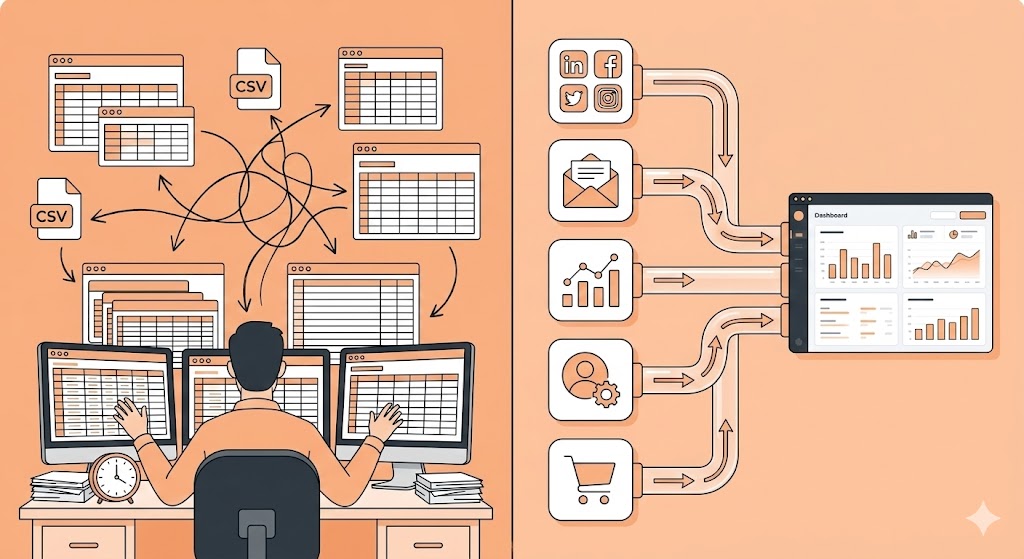
When faced with disparate data sources, most teams try to solve the problem manually. They export CSV files and combine tables. They also create their own reports. But over time, the amount of work increases and the risk of errors grows. The need for a systematic approach to marketing data integration becomes obvious. In practice, teams working with Google Ads, HubSpot, Meta Ads, and Shopify simultaneously often need to regularly transfer data to Google Sheets or BigQuery to build reports. Therefore, a tool that automates the import of data from dozens of popular services into tables or data warehouses without requiring code is necessary. This is what Coupler.io does: it supports scheduled data updates, reducing manual work and minimizing the risk of human error. For teams looking to systematize reporting and gradually transition to a more mature marketing data management model, such solutions are a necessary and logical step.
Disconnected platforms. Lack of a unified picture
Each advertising platform has its own attribution logic. Google Ads uses a click-based model. Meta Ads, on the other hand, may consider views. Accordingly, the same conversion is displayed differently in different interfaces. According to Gartner reports and other data, data integration is a leading marketing challenge. A comprehensive review, “CMOs, CEOs, and marketers are all struggling with martech data issues,” notes that approximately 65.7% of marketers cite data integration as the most difficult task in their martech stacks. This is directly related to data reconciliation across channels. When teams are unable to integrate marketing platforms into a single system, they encounter discrepancies in reports. This complicates budgeting. Integration allows you to:
- Apply the same data processing rules.
- Obtain a consistent picture of performance.
Inconsistent reporting. Time wasted
According to Supermetrics estimates, a significant portion of analysts’ time is spent preparing reports rather than analyzing them. When reporting relies on manual data export and copying, even a small mistake can lead to incorrect management decisions. Data integration solutions for marketing allow you to set up automatic updates of indicators. This ensures data stability. It is especially important for international teams. There, reports are used in different time zones and must be updated without delay.
How Data Integration Works in Marketing

It is a specific process with clear logic and stages. To understand why teams invest in these solutions, you need to understand:
- How data from different sources is combined;
- What changes after implementation?
Real-time marketing data integration as a competitive edge
If a campaign proves ineffective, even a few days’ delay can result in budget losses. Real-time marketing data integration lets you see changes in metrics almost instantly, or with minimal delay. According to a McKinsey study on data-driven organizations, companies that actively use real-time data:
- Have higher performance indicators;
- Adapt more quickly to market changes.
For marketing teams, this means the ability to quickly adjust bids, creatives, or audiences based on up-to-date information.
How does data integration work in practice
In basic terms, integration involves extracting data from sources, transforming it into a single format, and loading it into the target system. This is the ETL process. For marketing tasks, this means:
- Regularly receiving data from advertising accounts, CRM, and analytics platforms;
- Bringing them into a common structure.
If a team wants to compare advertising costs with actual sales, it needs to combine data from the advertising system and CRM. Without an automated ETL process, this would require constant manual intervention.
Centralized Insights. Improved Decision Making
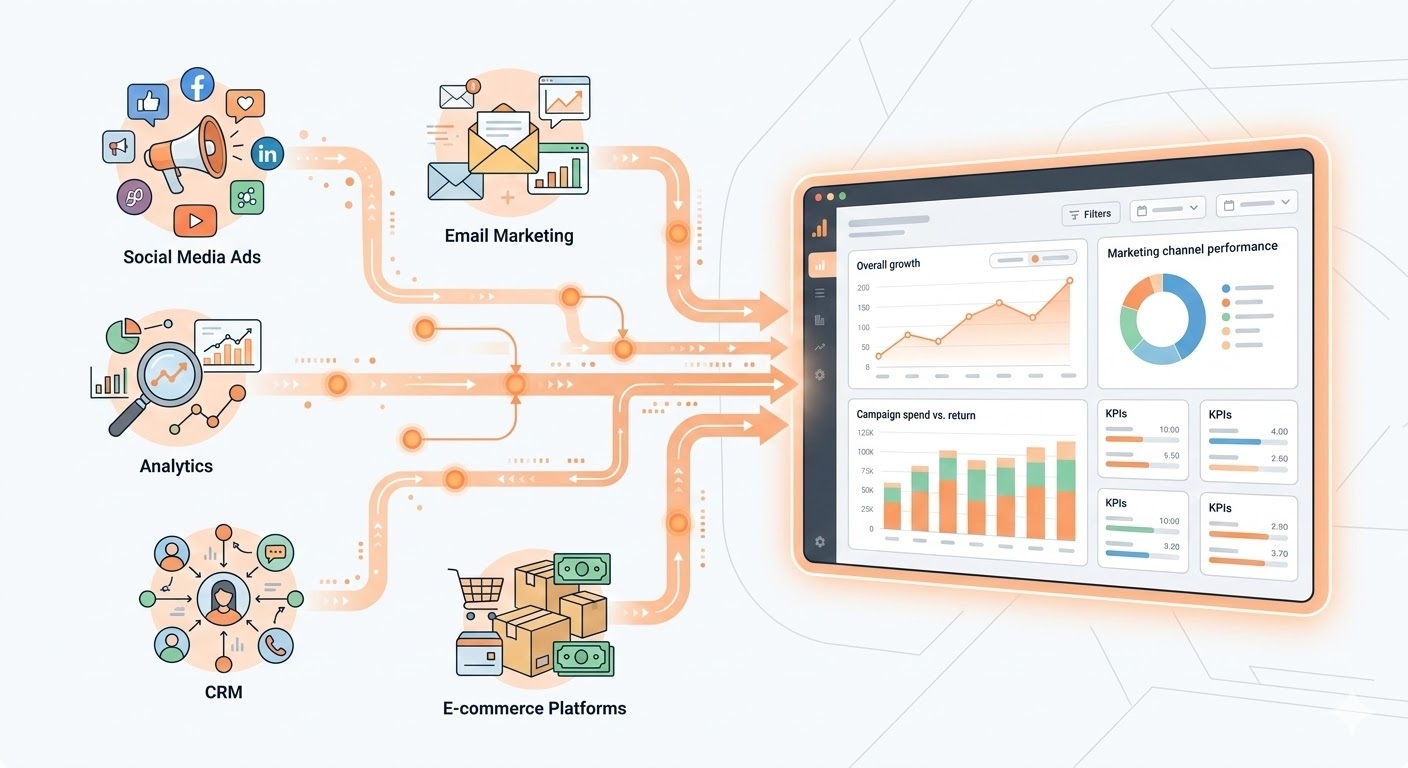
Even the most accurate data is worthless if it is isolated and not consolidated into a single coordinate system. Centralizing information transforms disparate metrics into strategic insights. The latter can be used to make informed decisions.
More accurate campaign optimization
When data is integrated, marketers can:
- Build more complex attribution models.
- Evaluate the real contribution of each channel.
By combining user behavior data from Google Analytics with advertising platform spending data, you can determine the actual cost of customer acquisition.
Data integration solutions for marketing also allow you to test hypotheses faster. If a new creative concept is launched simultaneously across multiple channels, integrated analytics allows you to:
- Quickly compare its effectiveness;
- Scale the best options.
Single source of truth
When all data is collected in a single repository, the team gets a so-called “single source of truth.” This reduces the number of internal discussions about the accuracy of the figures. In this way, it is possible to focus better on strategy. Harvard Business Review emphasizes in its data governance materials that consistent data is a prerequisite for high-quality management decisions. Marketing data management is becoming more structured. Clear rules for storing, processing, and accessing information are emerging.
Operational Efficiency. Cost Reduction
When data collection, updating, and processing are automated, manual work and associated risks are reduced.

Automation instead of manual work
Automating marketing processes can significantly reduce operating costs. Once integration is set up, teams spend less time on routine tasks. As a result, there is more time for strategic planning. Integrating marketing platforms means not just connecting APIs, but creating a sustainable ecosystem. One where data moves freely between tools. This reduces dependence on individual employees.
Scalability in growing companies
As a business grows, the number of channels and markets increases. Without systematic data integration, each new channel adds complexity. Instead, well-established marketing data integration allows you to scale operations without a proportional increase in the analytics team. It is crucial for SaaS and e-commerce companies to enter new markets rapidly. Centralized data helps:
- Compare results between countries.
- Make decisions based on real metrics, not local reports.
Bottom Line
Prioritizing data integration tools is the answer to the objective challenges of the digital age. Fragmented platforms, inconsistent reporting, and complexity in decision-making push teams to seek systemic solutions. Marketing data integration allows you to:
- Create a comprehensive picture of effectiveness.
- Ensure real-time marketing data integration.
- Build a reliable marketing data management model.
As a result, marketing ceases to be a set of disparate campaigns. It becomes an analytically sound, well-managed business function. Teams that invest in data integration solutions for marketing gain a strategic advantage. Namely, the ability to adapt quickly, make accurate decisions, and scale systematically.
About the Author
Jay Patel is the Founder of XSquareSEO, a full-service SEO agency with experience in on-page SEO, eCommerce SEO, link building, technical SEO, SaaS SEO, and local SEO. For more information, feel free to contact us.
Explore More Guides
Bold WP Font Styles
Fix WP Template Issues
White Page After WP Migration
WP Block Editor GHL
Top 10 SEO Analysis Tools
Construction Estimating Digital Marketing
Most Asked WordPress Questions
Managed WordPress Hosting Guide
Australian Business Digital Shift
5 Best Sentence Expanders