
Search has fundamentally changed, and Google’s AI Overviews now occupy prime real estate on results pages, answering questions before users click through to websites. For business owners and marketing managers who depend on organic traffic for leads and sales, this shift demands a new approach. I’ve spent the past year testing what works, and the playbook that follows distills how to turn search visibility into revenue.
This guide shows you how to structure content that both ranking systems and large language models can verify and cite. You’ll learn how to align with Google’s helpful-content guidance while still competing effectively in traditional results. You also get a practical 90-day plan and clear metrics tied to pipeline outcomes rather than vanity rankings.
Table Of Contents
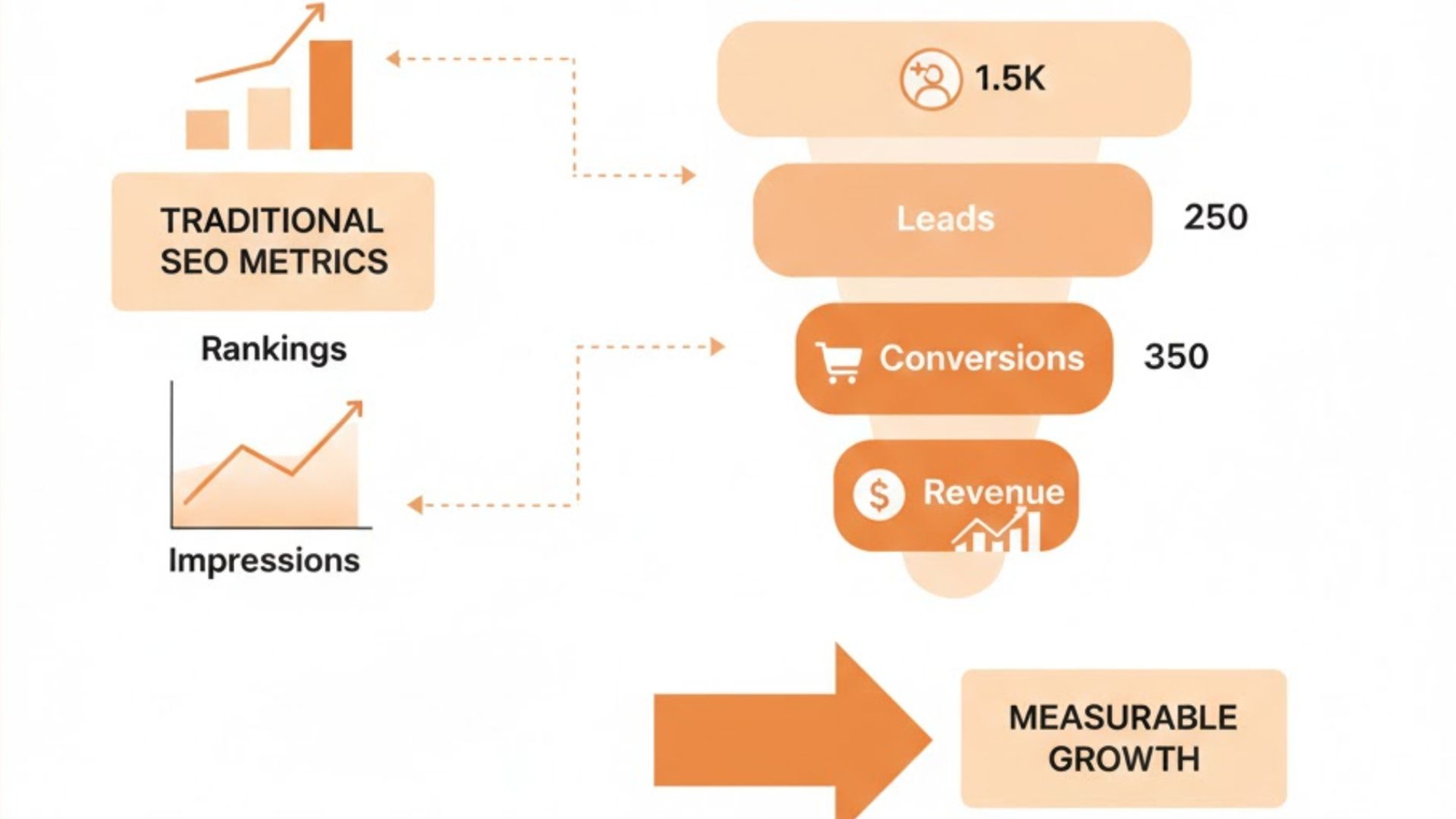
Prioritize Revenue Over Rankings In AI-Led Search
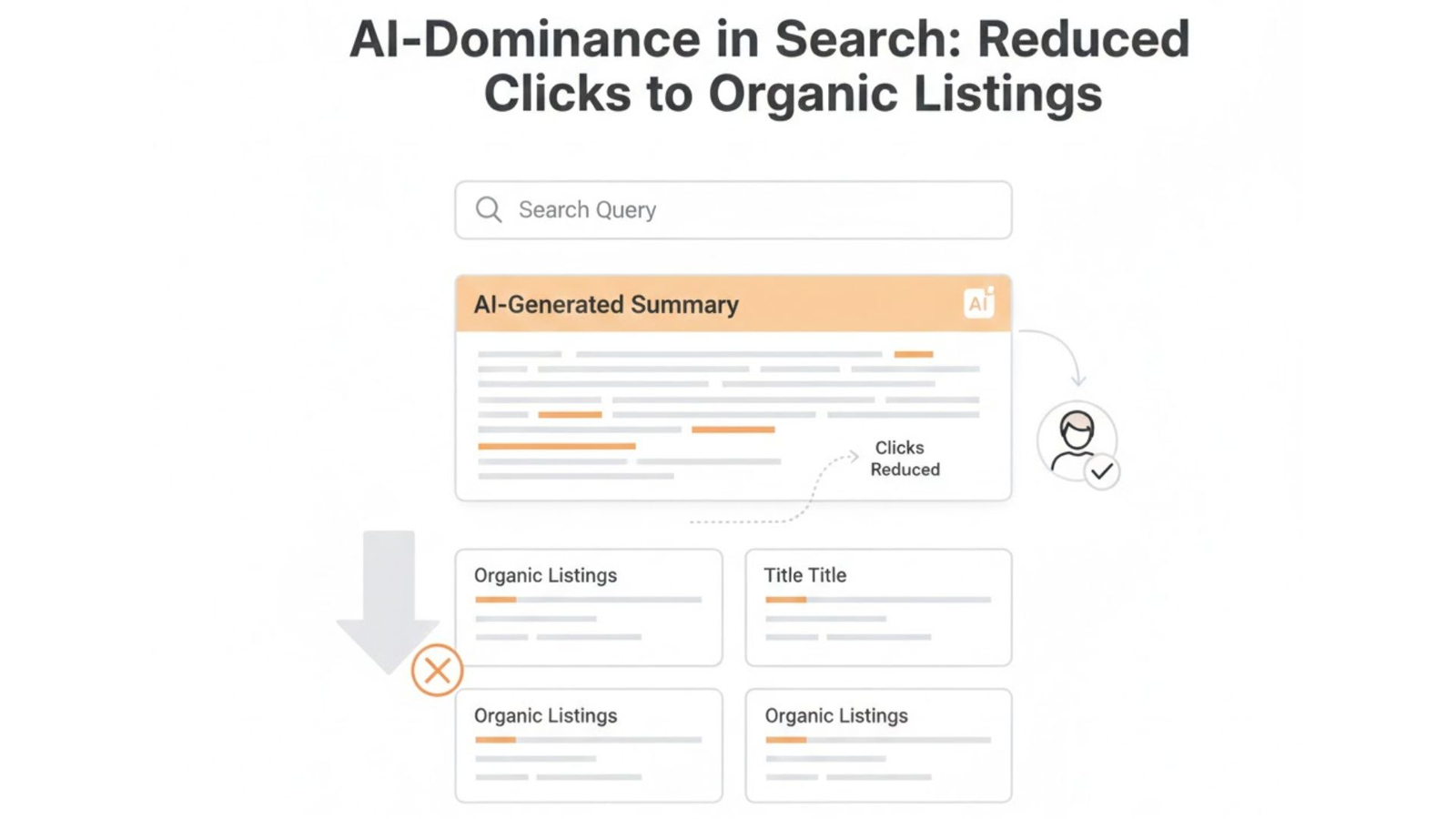
Rankings alone no longer predict business outcomes, and understanding this shift is essential before investing resources. Recent data from BrightEdge shows impressions rising roughly 49% while clicks declined nearly 30% after AI Overview expansion. More users now get answers directly on the search results page without visiting any website.
Google still dominates with approximately 84-85% U.S. search share according to StatCounter. Research from seoClarity observed AI Overviews appearing for about 30% of U.S. desktop keywords by September 2025, up from roughly 10% in March 2025. Mid-SERP positions (3-6) have lost significant click share as these AI summaries push traditional organic results further down the page.
Winners in this environment treat AI Overviews as both visibility and referral opportunities. They create content designed to be cited within these summaries while still earning clicks from users who want deeper information. The goal is not just ranking, it is becoming the source that AI systems quote when answering questions in your market.
Use AI SEO Where Organic Leads Drive Sales
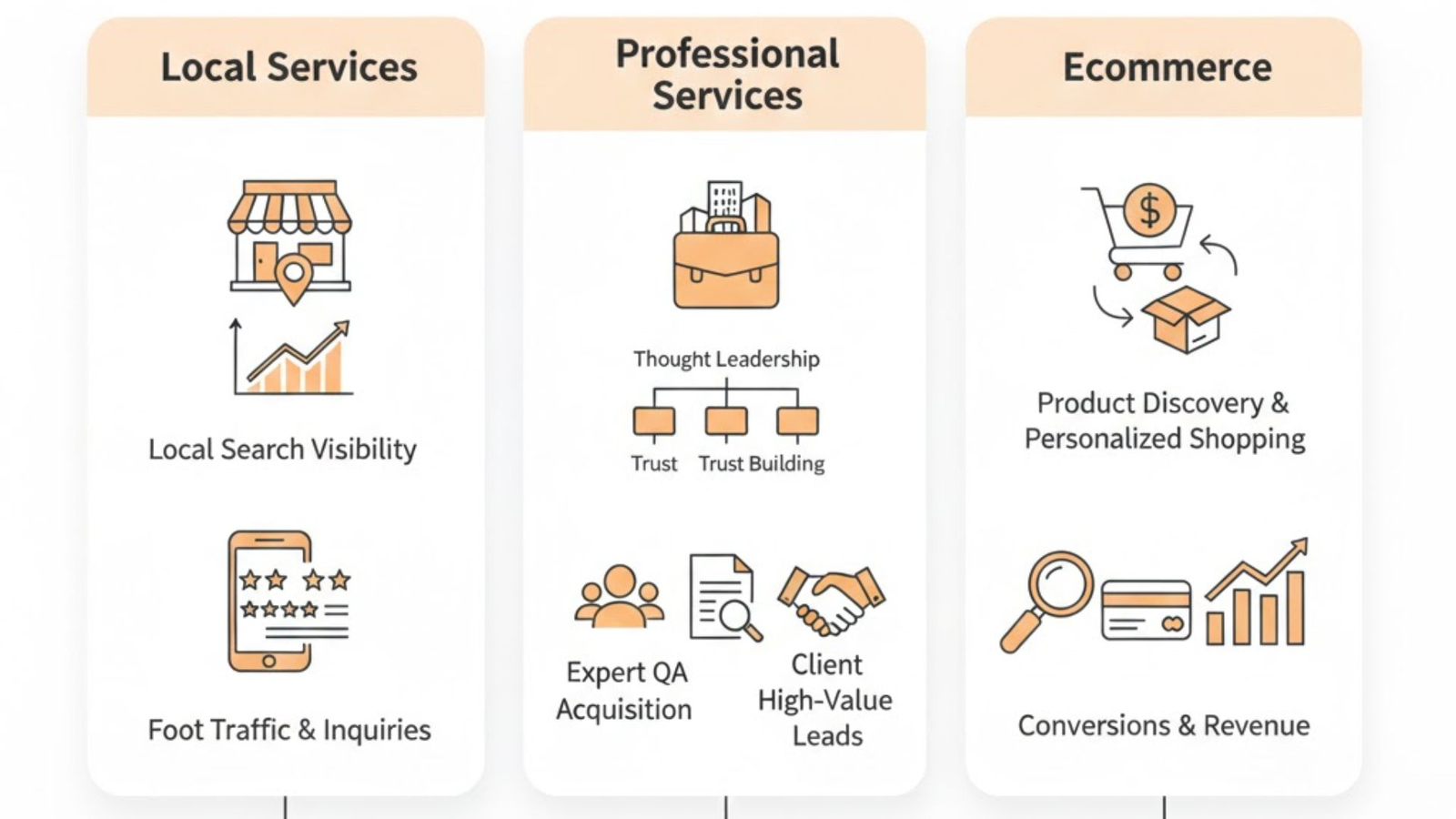
This framework works best for U.S. small-to-mid-sized businesses that need predictable leads from organic search. I’ll anchor tactics to three common business models so you can map recommendations directly to your revenue situation.
Local Service Providers
Dentists, urgent care clinics, home service companies, and similar businesses need booked appointments and phone calls. Key pages include service pages for each city served, symptom explainers, and urgent availability information. Conversion offers typically involve online scheduling, click-to-call buttons, and insurance verification tools.
Professional Service Firms
Estate planners, employment lawyers, accountants, and consultants need qualified consultation requests. Key pages include state-specific guides, comparison content such as “LLC versus trust”, and case studies demonstrating outcomes. Conversion offers center on free consultation slots and intake forms with screening questions.
Direct-to-Consumer Ecommerce
Shopify and similar merchants need checkouts and email capture. Key pages include high-intent collection pages, product detail pages, comparison guides, and shipping FAQs. Conversion offers usually leverage free shipping thresholds, bundles, and subscription options.
Use AI To Support, Not Replace, SEO Judgment
Clear definitions prevent costly misunderstandings about what is allowed and what drives results. AI SEO means building people-first, expert content that both ranking systems and large language models can verify and cite. Automation can assist research and production, but it should not replace editorial judgment.
Google states that AI-generated content is permitted when it is helpful and not used to manipulate rankings. The March 2024 update refined ranking systems and reduced low-quality, unoriginal content by about 45% upon full rollout. Scaled content abuse remains prohibited, whether created by AI, humans, or both, when the intent is manipulating rankings.
Key Terms You Need to Know
- AI Overviews: Google’s AI-generated summaries that cite sources within search results pages
- Answer-engine optimization: Structuring content so AI systems can extract and cite accurate answers
- E-E-A-T: Experience, Expertise, Authoritativeness, and Trustworthiness, signals search engines use to assess credibility
- YMYL: “Your Money or Your Life” topics, such as health, legal, or financial advice, that require higher content standards
Related Articles
Is AI Content Bad for SEO? Exploring Algorithm Impact, Benefits, Risks & Best Practices
Does AI Write Seo-Optimized Content 3x Faster Than Human Writers
Does ChatGPT Generated Text Hurt SEO? Truth, Impact, and Fixes
Tie Every SEO Initiative Directly To Pipeline
Back-planning from revenue ensures every content and technical investment connects to pipeline metrics. Define primary KPIs first, such as qualified calls, form submissions, booked appointments, checkouts, and CRM-tracked assisted conversions. Secondary KPIs include AI Overview citations, rank-bucket click-through rates, Local Pack actions in Google Maps, and Core Web Vitals performance.
Instrument GA4, Search Console, call tracking, and your CRM so stages connect from impression to revenue. Set weekly targets and verify that data collection works correctly. Create clear definitions for “qualified” events, such as a call lasting over 60 seconds or a form submission with all required fields completed.
Simple KPI Tree Structure
- Top level: Revenue from closed deals
- Middle level: Opportunities by source, qualified leads, assisted conversions
- Base level: Traffic by intent cluster, AI Overview citations, SERP click-through rates, page speed
Turn Customer Struggles Into Searchable Content
Understanding real customer struggles reveals the query patterns that drive revenue. Use Jobs-to-be-Done interviews with 5-10 recent buyers to capture “struggling moments”. These are structured conversations that unpack what “job” the customer hired you to do and map to search patterns across symptoms, comparisons, costs, and local availability.
A dentist might discover that “throbbing molar at night” leads to searches like “toothache vs sinus” and “emergency dentist near me”. This maps to a symptom guide plus city-specific pages, with same-day booking as the conversion offer. A law firm might find that “mom passed without a will” triggers searches for “probate timeline California”, which calls for a state guide with consultation booking.
Deliverable: a spreadsheet mapping each job-to-be-done to query patterns, content types, and conversion offers for your top two revenue topics.
How to Rank in AI Overviews? Optimize Content for AI Visibility
Fix Crawl And Speed Issues Before Scaling Content
If search engines and AI systems cannot crawl and understand your pages, nothing else matters. Fix indexation, internal linking, structured data, and page speed before scaling content production. Google recommends that every important page receive at least one internal link with descriptive anchor text.
Priority Technical Fixes
- Clean XML sitemaps and robots.txt configuration
- Canonical tags properly implemented across the site
- No accidental noindex directives on money pages
- Orphan pages resolved with contextual internal links
Deloitte research found that a 0.1-second mobile speed improvement correlated with significant conversion lifts in retail contexts. Aim for Largest Contentful Paint under 2.5 seconds, Interaction to Next Paint under 200 milliseconds, and Cumulative Layout Shift below 0.1 on mobile. Prioritize service pages, product detail pages, location pages, and top articles for speed work.
Package Clear Answers, Evidence, And Experience
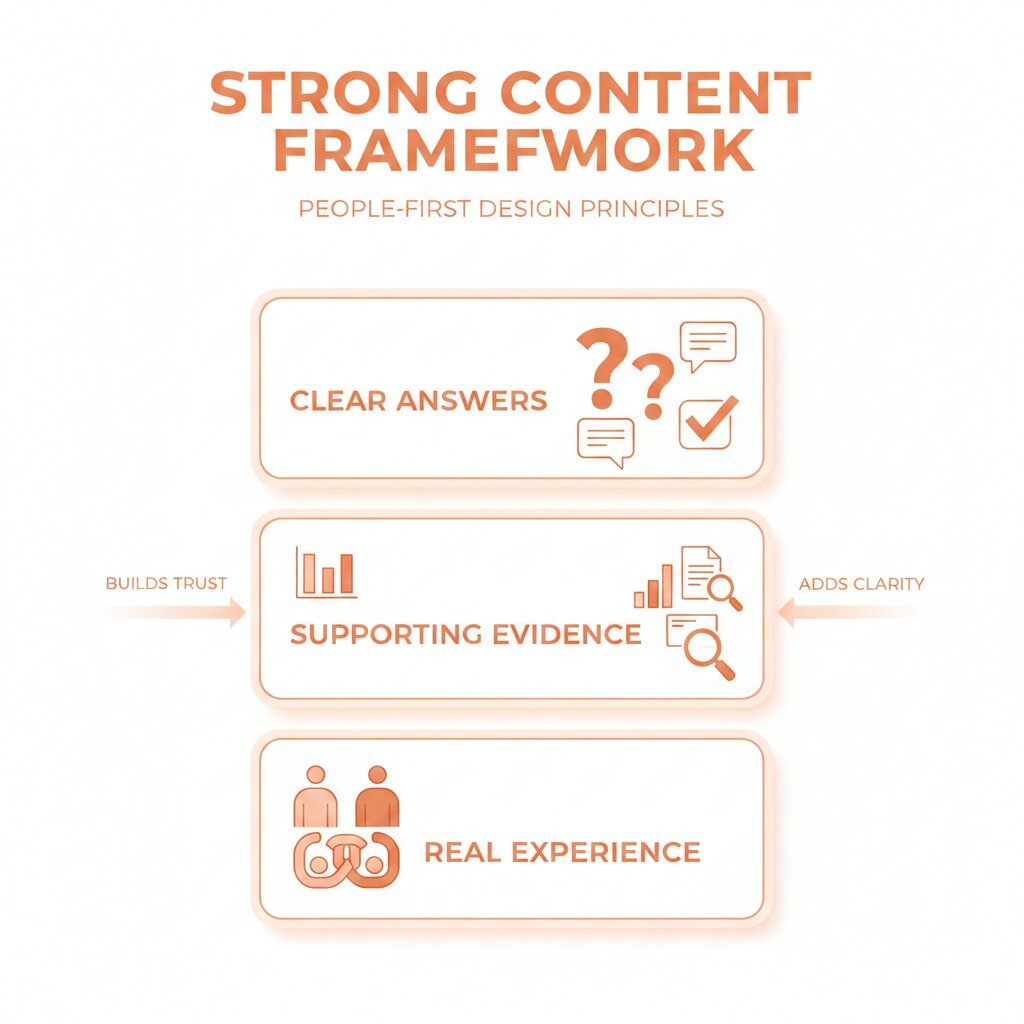
The Answer plus Evidence plus Experience framework makes pages quotable by AI while still persuading human readers. Lead with a clear, sourced answer in the first two to three sentences. Back it with data, structured markup, and relevant media, and layer in lived experience through procedures you perform, photos you took, and results you achieved.
Show “Who, How, Why” transparency: who created the content, how it was produced, and why it exists. Google recommends this approach for helpful, reliable content. Add comparison tables, mini-FAQs with schema markup, step-by-step processes, and outbound links to primary sources.
SearchPilot tests have observed 4-15% organic traffic uplifts from adding FAQ schema, though results vary by site and vertical. Use FAQPage schema for embedded question-and-answer blocks. State limitations honestly and indicate when readers should consult a professional, especially for health, legal, and financial topics.
Keep AI Assistance Inside Clear Quality Guardrails
AI accelerates research and drafting but requires guardrails to protect accuracy and compliance. Useful applications include topic clustering, brief creation, schema suggestions, and internal-link recommendations. Humans must own fact verification, brand tone, and risk assessment.
Create an AI usage policy that defines acceptable use cases, such as drafting outlines or generating schema code, and prohibited activities, such as unreviewed medical or legal advice. Maintain logs of prompts and outputs. Require editor sign-off before publication and disclose AI involvement when appropriate for your audience.
Reference the NIST AI Risk Management Framework, a U.S. standards guide, for high-level guidance on transparency, oversight, and evaluation. Audit content quarterly for accuracy and user feedback. Remove or substantially improve thin pages that do not serve users.
Organize Content Into Deep, Coherent Topic Clusters
Depth beats breadth when you are establishing your site as the go-to resource for a topic. Develop clusters with hub pages and supporting spokes that cover core questions, comparisons, costs, and local variations. Plan internal anchors intentionally with navigational and contextual links that guide users and crawlers.
For a dental implants cluster, the hub page covers overview and candidacy. Spokes address cost factors, procedure steps, risks, aftercare, insurance coverage, city-specific pages, before-and-after galleries, and detailed FAQs. Every spoke links back to the hub and two to three sibling pages, and you add LocalBusiness schema on city pages and FAQPage schema where relevant.
Mirror Cited Pages To Earn AI Overview Mentions
Pages that get cited in AI Overviews share common structural elements you can replicate. BrightEdge found that the share of AI Overview citations from pages that also rank organically rose from roughly 32% to 54% over sixteen months. For a deeper step-by-step playbook on structuring pages to surface in AI-led results, study Grow and Convert’s detailed guide that shows you how to increase AI visibility, then adapt the checklists here to your highest-revenue topics.
Tactics That Improve Citation Likelihood
- Add a one-paragraph definition or summary near the top with a bolded key sentence
- Use FAQPage, HowTo, Product, and LocalBusiness structured data consistently
- Keep entity names, such as brand, staff members, and locations, identical across pages and profiles
- Publish calculators or original data tables that others can reference
Create a weekly watchlist tracking priority keywords, AI Overview presence, and which domains get cited. Compare your page structure to cited competitors. Upgrade answer quality, add missing schema, and strengthen internal links to close gaps.
Follow A Focused 90-Day SEO Execution Roadmap
Prioritized action beats comprehensive planning when resources are limited. Ship high-ROI fixes first with clear ownership and a weekly review cadence.
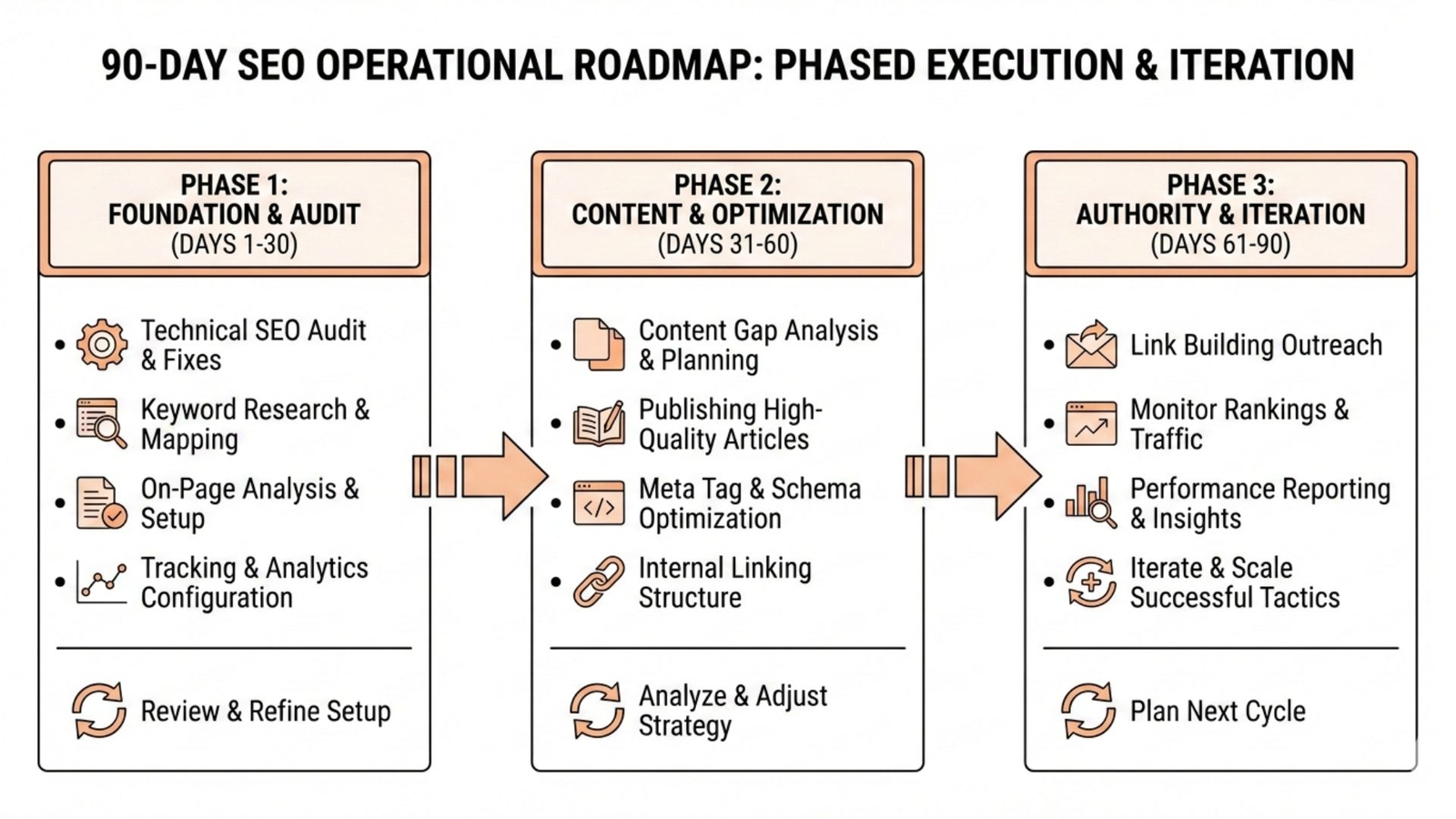
Days 1-30: Foundations
Run technical and content audits, fix indexation issues, and improve speed on your top twenty URLs. Implement structured data on those same pages and publish two revenue-focused clusters with a hub page and three to five spokes each. Add internal links from high-traffic pages to money pages.
Days 31-60: Scale and Local Presence
Publish four cluster pages weekly and conduct a site-wide internal-link audit. Overhaul your Google Business Profile with complete categories, fresh photos, and answered questions, and launch a review request program. Begin monitoring AI Overview citations and logging gaps.
Days 61-90: Expand and Evaluate
Refresh decayed content, older content showing traffic decline, and expand to a second priority topic. Ship one original-data asset, such as a survey or industry analysis, and pursue public relations outreach selectively. Review your KPI tree against actual pipeline movement and refine forecasts for the next quarter.
Eliminate Predictable SEO Failure Patterns Early
Predictable pitfalls derail otherwise sound strategies, and knowing them in advance saves months of wasted effort. Scaled thin pages waste crawl budget and do not convert, so build depth in two clusters before expanding breadth. Ignoring internal links confuses crawlers and users, so add contextual links from hubs and top-traffic posts, then audit quarterly.
Skipping authorship signals undermines credibility, so add bylines with credentials and production notes to key pages. Over-relying on AI drafts risks inaccuracies and spam-policy violations, so enforce human review and fact-checking, especially for YMYL content. Chasing head terms exclusively misses conversion opportunities, so prioritize service and location pages with clear offers.
Run SEO As An Ongoing Operating System
Sustainable results come from disciplined execution tied to business outcomes, so use the KPI tree and 90-day plan to focus on what moves bookings, qualified leads, and revenue. Review metrics weekly with your team. Maintain governance discipline to avoid spam-policy risks as you scale.
Keep investing in page speed, structured data, and topical depth. These compounding assets earn both AI Overview citations and traditional organic wins. The businesses that thrive in AI-shaped search are those that relentlessly serve users with helpful, transparent content while measuring what actually matters, including pipeline and profit.
About the Author
Jay Patel is the Founder of XSquareSEO, a full-service SEO agency with experience in on-page SEO, eCommerce SEO, link building, technical SEO, SaaS SEO, and local SEO. For more information, feel free to contact us.
Explore More Guides
WP Block Editor GHL
Top 10 SEO Analysis Tools
Construction Estimating Digital Marketing
Most Asked WordPress Questions
Managed WordPress Hosting Guide
Australian Business Digital Shift
5 Best Sentence Expanders
Marketing Data Integration Tools
SEO Tips for Tech Startups